
A Blog by Bruce Baker

Learn About the Book or click on the cover to purchase.


Twitter Feed

Powered by Squarespace

Use OpenDNS

Search
Subscribe to Blog

Subscribe to Podcast
Contact Me
Blogroll

Saturday
Sep082012

When a Believer Dies

I read an article recently that encouraged the blogging of letters that others might find valuable. My last post followed this model. Quite a few have responded positively to that letter (though curiously not through the comments section). Now once again I find myself writing a private letter on a topic that others may find helpful. I’ve decided to start posting such letters as they occur, omitting those items which may identify the recipient. My prayer is that God will use these public letters to strengthen his people.

 ______________________

Dear _________,

Please accept my most sincere condolences on the death of your mother. Even though her illness made such an event only a matter of time, the actual death is always so painful. Oh, we think we are prepared, but in reality one can never really be prepared for the death of one we love. 

I’m thankful that God heard our prayers uttered over these many months and that “her passing was peaceful.” It is also an indescribable blessing to know that “she was at peace with death and confident in her faith in Jesus.” You are quite correct that such knowledge gives peace and hope for the future. 

As a pastor for many years, and having mourned the death of both my parents, I’ve discovered a few truths about death that people who have never gone through it don’t realize. These aren’t Bible truths, but the numerous funerals in which I’ve participated have proven them true.

  1. When a parent dies, you’re nine years old again. It doesn’t matter how old you really are, what responsibilities you carry, what marks of maturity are evident in your life. The basic relationship that defined the bond between you and your mom overrides all other truths. Oh, you may continue to act the part of a mature adult, but the raw emotions that burrow a hole in your stomach are those of a child. 

  2. When the second parent dies, you’re an orphan. The safety net that parents provide may not have functioned for decades. In fact, you may have been the caregiver for your parent. But even though the roles are reversed, your memories of the ones who could “make it better” overwhelm you. The loneliness that is an integral part of all grief is even more intense when the second parent dies.

  3. It hurts a lot more than other people know. Even those who have endured the grief you now experience have had the memory of the gnawing, devastating grief dulled somewhat by time. This is just another reason why the mind-numbing pain we experience makes us feel so alone.

  4. It hurts a lot longer than other people realize. In a few weeks, other people’s lives will return to normal, but yours won’t. It will take about a year before the ache truly begins to subside, for it will take a year to get by all the “firsts”: the first Thanksgiving, the first Christmas, the first birthday, the first Easter, etc. You will get better, but not as quickly as others imagine. And no, you can’t just “get over it” even though others may expect you to.

All of the above is merely the fruit of my experience and observation. But at a time like this, what we really need is God’s perspective, not merely on death, but on the death of a believer. Because even though I may be able to describe the grief we experience, there is nothing in my words that can comfort. Only God’s Word can do that.

The Old Testament’s standard way to describe God’s character is that he is “gracious and compassionate, slow to anger, and abounding in love” (Psalm 103:8 among many other passages). Because God is who he is, death for a believer is changed from a terrible curse to a good and gracious gift. 

To say that death can be a good and gracious gift is not to deny the evils associated with death. Death, the Bible teaches, is the consequence of sin. Death brings separation and sorrow. In fact, the Bible always portrays death as an enemy that has invaded the land of the living.

Even the Lord Jesus did not look forward to his death, despite his confidence that he would be raised from the grave. But the Bible does teach us that God is able to use what is, in and of itself, evil, in order to bring about what is good. 

Rom. 8:28 And we know that in all things God works for the good of those who love him, who have been called according to his purpose.

 Understanding that God works things together for good, even an evil such as death, it seems appropriate to ask what happens when a believer dies. What is it about a believer’s death that so changes the experience? Well, there are at least four truths concerning death that apply to all believers.

So what is death for a believer?

  1. Death is a key in a Door

Rev. 1:18 I am the Living One; I was dead, and behold I am alive for ever and ever! And I hold the keys of death and Hades.

The fact that he holds the key to death means that no one dies unless he puts the key in the door. In other words, no army no matter how great can kill me unless Christ puts the key in the door (I remind people of this truth every time I go to Africa). In the same way, no team of doctors can save me if he uses the key.

This is a great comfort when you understand who God is. As I stated above, the standard way to describe God is that he is gracious and compassionate, slow to anger and abounding in love. Knowing this to be true, we can be assured that he waits until the absolute best time, having weighed the alternatives, to put the key in the door. In the same way, we can also be assured that if we had the ability to go back and undo that doctor’s report, undo all the tests, undo the illness, we would only make things worse. Jesus knew the right time before he put the key in the door.

And this also shows that this was really no mere chance occurrence. There is no such thing for a believer. God knew the best time and so arranged circumstances that he brought about the best for your mother and for you, for her entire family and even her friends. 

2. Death is a Change in Location

2Cor. 5:6 Therefore we are always confident and know that as long as we are at home in the body we are away from the Lord.  7 We live by faith, not by sight.  8 We are confident, I say, and would prefer to be away from the body and at home with the Lord.

 We must remember that the body that was laid to rest was not your mother. She experienced a change in location when she died. If death were all that there is, if it was really the end, then we would have the right to mourn without ceasing because there would be no way to ever see our loved ones again. But death isn’t the end.

Instead your mother is now experiencing the joys of heaven where there are pleasures at the right hand of God forever more. She now looks upon the unveiled face of God in all his holiness, and experiences freedom from the sins that plagued her and the physical ills that were her constant companions. Her body is laid to rest here, but your mother is not here. 

She is in heaven waiting for that great day “when Lord himself will come down from heaven, with a loud command, with the voice of the archangel and with the trumpet call of God, and the dead in Christ will rise first. After that, we who are still alive and are left will be caught up together with him in the clouds to meet the Lord in the air. And so we will be with the Lord forever.” (1 Thess 4:16-17)

3. Death is an Answer to Prayer

John 17:24  “Father, I want those you have given me to be with me where I am, and to see my glory, the glory you have given me because you loved me before the creation of the world.”

Jesus so loved your mother that he prayed that she would one day be with him in heaven and would be able to behold his glory, a glory far greater and more wonderful than anything that this world could produce. And so, even though our hearts are breaking, God has said no to our prayers for just a while, so that he could answer the prayer of his Son. 

Of course, one day this prayer will be answered for us all. We will all be gathered together with those that have gone on ahead, and we will all together behold his glory forever more. Still, until that time, we can rejoice that your mom is there now, experiencing the glory of God, even though we must wait a while longer.

4. Death is the Delivery of a Gift

Eph. 2:8 For it is by grace you have been saved, through faith — and this not from yourselves, it is the gift of God —  9 not by works, so that no one can boast.

In one sense it is true that we may enjoy eternal life in the here and now, but it is also true that the entire benefits of this gift of God are not realized until we are in his presence. Your mother has received this gift. She knew what it meant to be saved by grace alone apart from works. And now, because of God’s grace, she has received in full the gift that God has promised to all who believe.

Understanding this gift means that we realize that this is not our true life, or final life.  There is something so much greater and so much more significant than the life we now live in the flesh.  There is something beyond the present, so much more important than the present, that what is now is scarcely worthy to be compared with it.  

The present life can be compared to the training ground for eternity.  It is the mere entrance, like a porch on a great mansion.  It is like the preface to a book which contains many chapters.  And while the porch of a mansion might be beautiful, it is vastly inferior to the wonders that lie inside.  The preface of a book gives us some clue as to the author’s purpose, but it is not the important feature.  Both the porch and the preface are insignificant in comparison to that to which they lead.

 In the same way, our life now is so vastly inferior to the life that is to come, that we may rightly say that your mother has entered into the life that God gave her so long ago as a free gift.

Your mother will forever experience the glories of God’s holiness. She will forever enjoy a banquet of pleasures that God has promised are at his right hand. She looks forward to an eternity of blessed contentment and will spend endless hours of unbroken fellowship with the Savior who loved her so much that he died for her.

I know _____, that you have this same hope. And while I have no delusions about the reality of grief, God desires that we do not “grieve like the rest of men, who have no hope” (1 Thess 4:13) Please be assured that I will continue to pray to this end, just as I prayed for you and your mother these past months.

Mourning and Rejoicing with you,

Bruce

Friday
Aug312012

A Public Response to a Private Letter

Dear ______,

Let me begin by lightening your heart. I assure you there is no problem between us. I haven’t been offended in any way. There is absolutely no damage done to our friendship and relationship in Christ. 

I want to thank you for your email. In fact, I’d like to commend you for even writing in the first place. Most people wouldn’t. To write in such a way as to make yourself vulnerable and open to criticism, all for the sake of harmony in the body, is a bold move. To ask if your actions have offended invites a critical, even hostile, response.

Similarly, to speak in favor of another brother, taking the side of love and assuming the very best of intentions, risks being dragged into a dispute not of your making. For the record, I am aware of no issues between myself and the brother you mention. Still, you had no way of knowing that. 

People are unpredictable. And since all people have had their lives ravaged by sin, that volatility all too often expresses itself in bitterness, malice, and hostility. Everyone has experienced, at one time or another, shock and bewilderment as rancor and venom spew from the lips of those we considered friends over some completely unintended word or slight. Sometimes we are able to repair the damage done, but all too often we cannot. The hopelessness, the feeling of loss at such times is overpowering. 

On the other hand, it seems more common for people to take offense at some snub (real or imagined) but never let you know. Oh, over time you notice a difference in the relationship. The warm camaraderie that was previously enjoyed is now merely a cordial exterior. There is always some reason why the invitation to spend time together is not accepted. The friendly slap on the back eventually turns to a cold shoulder. When you begin to search for the basis of the change you are assured there is nothing wrong or (more likely) that they don’t want to talk about it.

In the very worst cases you later learn from a mutual “friend” the real problem. You discover that many others know as well. Enough time has passed that hurt feelings have hardened into permanent resentment. As the story has gotten round (each time worse in the telling), your reputation is damaged, your character besmirched, your good name slandered.

And the real tradgedy is that all of this is avoidable. If people…if believers……if brothers and sisters in Christ would simply love more, repent quickly, forgive freely, be tender always, the shambles that exist in so many churches would be gone. To be more explicit, if more people would reach out in love early, at the first hint of trouble, and seek reconciliation (as you have done) then Jesus’ prediction would be a reality (John 13:35).

Oh to be certain, such a loving response is not really optional. We are commanded to reconcile with each other. In fact according to Jesus, being reconciled to a brother is more important than worship (Matt 5:23). But few in the body seem to take that seriously. 

I’m thankful you’re one of the few.

With much gratitude and tender affection in Christ,

Bruce

Thursday
Aug302012

The Royal Drummers of Burundi

Here are the first of several videos I hope to make available of the world famous Royal Drummers of Burundi practicing in Bujumbura. As you might expect, this video in no way does them justice. When they play you can feel the percussion against your chest. There simply is no way to describe it.

Martin and a “senior” pastorThis was my fourth trip too Burundi. Everytime I’ve come, I’ve asked to see these talented performers. It’s never worked out until this year. Martin (pictured right) seemed to know immediately why this year we were able to see them when we hadn’t been able to before.

He leaned in close, poked me in the arm and grinned, “You got to see them this year because your brought a brother along!” Then he laughed. Martin has one of those bosterous, outragious, infectious, over-powering laughs that makes everyone’s head turn his direction. Of course, his laugh makes everyone else laugh, including me. 

In response, I told Martin that if I wanted to get anything done in central Africa, then I’d have to bring him along every year. I think he’s considering it!

Saturday
Aug182012

North to Bubanza

Yesterday was our last official day of ministry here in Central Africa. We traveled north from Bujumbura to a medium sized town called Bubanza.

As you can see from the map on the left (click the map for a larger view), we were headed along one of the major roads of Burundi. What this means is that the road was paved. What this doesn’t mean is that the road was any good. Oh certainly, as we traveled further and further north towards Rwanda, the road got much better. By the time we reached Bubanza, the road was so good it would rival the best roads in the US. But most of the way north, the road was beyond bad—it was terrible. 

There were huge potholes that spaned nearly the entire width of the road. Traffic would have to slow to a crawl to cross them. This meant that the ride was a continuing oscillation between spreading up as fast as you could go and then slamming on the breaks to avoid wreaking your car on the potholes

Of course, if the pothole didn’t span the entire road, then the driver would weave back and forth across the road, missing as many as he could. This often meant leaving the road all together and driving for a bit on the shoulder. Unfortunately, the weaving, the bouncing, and the jerking forward and backward as you either sped up or slowed down, was too much for poor Joseph. Just as the road began to get slightly better, we had to pull off to the side to allow him to…..er……..breath a little bit.

Fortunately, he held down his………um…….he began to breathe easier, and we were able to continue after about 15 minutes. Martin and I definitely felt sorry for him, but we didn’t let him know that. The wise-cracks were flying pretty thick, which caused Joseph to smile for a couple of seconds between that “I don’t feel so well” look returned. 

When we finally reached Bubanza, we found it to be a medium sized town for Burundi. Remembering it’s Burundi we’re talking about, that doesn’t mean all that much, but still, it’s bigger than a village. The nicer buildings were all along the main road. By “nicer” I mean made out of regular bricks, not the mud bricks that are the mainstay of most architecture in this part of the world. We made our way past those buildings to a rutted dirt path and got as close to the church as possible. Then we walked.


It wasn’t a far walk, but as Joseph put it, we picked up a posse pretty quick. The dirty ragged children followed us to the church, staring at us as if we were side-show attractions. And to them at least, I guess we were. My guess is they don’t see many mzungu in Bubanza.

The church itself was made of sticks resembling bamboo, had a thatched roof and a mud floor. While the congregation didn’t seem to mind the rude dwelling, the lack of obvious prosperity is a detriment to the church. It seems some of the other churches in the area (mostly Pentecostal and Roman Catholic) have spread around the accusation that this church must be a cult or it would have a better building. No, it doesn’t make any sense, but that doesn’t change the facts.

There were about 400 in attendance at FiziWhen I spoke at the general convention in Fizi, I spoke from Luke 7:11-17. In recounting the story of the Widow of Nain, i emphasized how Jesus’ compassion was kindled when he saw her. He didn’t see the crowd, he saw her. I mentioned how Jesus is the same “yesterday and today and forever.” This was a message of comfort for those in Congo. As the region once again is on the brink of all out war, many in the congregation—particularly those from Bukavu, have an uncertain furture ahead of them. They needed to hear that Christ viewed their sorrow with compassion.

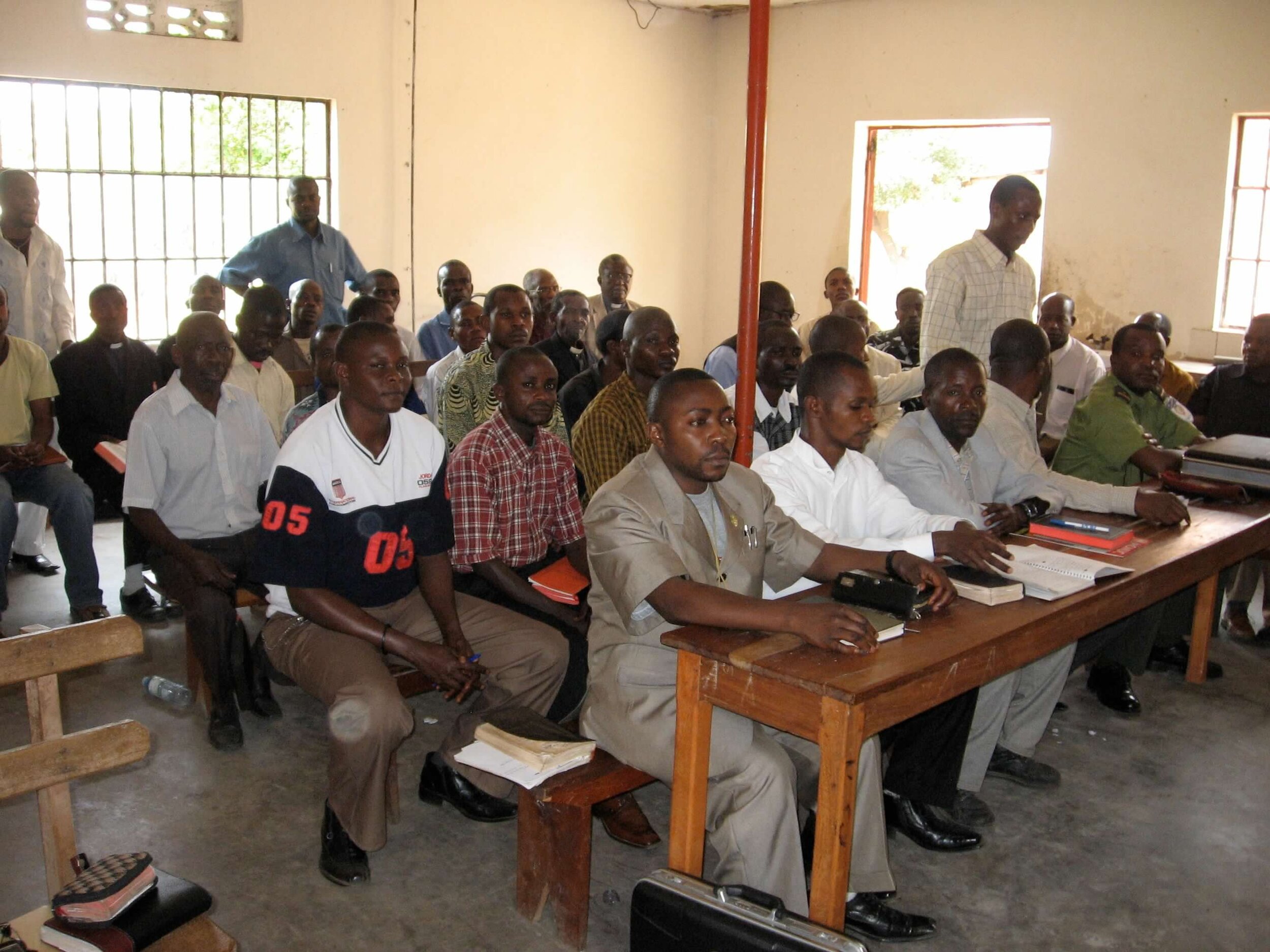
Teaching the pastor’s from REMAC is always an extremely rewarding experience. They are obviously hungry to learn the Word and ask a plethora of questions about real-world ministry.

Preaching to their congregations, on the other hand, I’ve always found difficult. They sing and dance (boy oh boy, do they dance: see 2 Sam 6:14), and when they’re done, I preach. Often they seem so worn out that they don’t have the ability to listen. But when I told this story, the majority of the congregation seemed to respond.

Among the crowd was the pastor of the church in Babanza. He specifically asked me to preach the same sermon to his church, since few from his church were at Fizi. So I did as he asked. Interestingly, Martin commented that I preached the sermon differently in Bubanza than I did in Fizi. I didn’t purposely do anything different, but Martin commented that the Holy Spirit took control so that they heard exactly what they needed to hear. I pray he is correct. 

This much I do know: they were moved by the story of Jesus’ compassion. When it came time for the service to end, no one seemed to want to leave. One would break out into a song and the drums would start and the people would sing. Then they would be dismissed again, and another would start to sing. I can’t say this never happens in North American churches, but I can say I’ve never witnessed it.

Tomorrow we fly home. The trip will be long as we are far, far away. And while Martin and I are eager to return to our families, we are experiencing a certain sadness about leaving these people that we have come to love. Joseph isn’t eager to leave at all. He openly wishes he could stay longer. I don’t know how to explain it. I love the people back home: my family, my church, my friends. But I love these people as well. Leaving tomorrow will be tough.

Thank you for praying for us. Your prayers have done more than you can possibly imagine. I know that sounds like preacher talk, but it isn’t. What we have experienced is a genuine movement of God among these people. God has been gracious enough to allow us to participate. You prayers have allowed you to participate as well.


Monday
Aug132012

Once Upon a Time in Congo…


Congolese Flag flies at the BorderSaturday Martin, Joseph and I crossed the border into Congo DR. There was no difficulty getting through immigration control although the apparent attitude of the officials at the border did make us a little tense. We kept our voices lowered (even Martin, at least for the most part), and quietly waited while our papers were carefully examined by the Burundi agent. Then we walked across a short bridge to the Congolese side, where an equally somber clerk completed the requisite paperwork.

We thought we were done at that point, but we drove only about 1/4 of a mile when we had to stop again for customs. Martin was concerned that he had left money in his suitcase, and started to get out of the car. I informed him in calm tones that he would only raise suspicion if he got out to get his luggage and that he should get back in the car, which he did. The official walked around the car—slowly, deliberately—and then let us go. If he had decided to open our luggage we would have been there for a while.

Through it all, God was merciful to us. We had no troubles, sailed through the border crossing (comparatively speaking) and were on our way to Uviria


The view of Uvira across Lake Tanganyika from Villa IliacOur hotel is nicer than the one we stayed at in Bujumbura. The Villa Iliac is nestled right against the shore of Lake Tanganyika. This gives us a beautiful view, but also brings plenty of mosquitoes. It’s a good thing the beds are equipped with large mosquito nets. The staff tucks the nets under the mattresses every day so you only have to let loose enough to crawl in. Even so, when it’s really quite, you can still hear the thirsty critters buzzing around.

Yesterday was our only day to attend the REMAC conference for this year. The teaching of the pastor’s always precedes the actual conference for the churches. There were five or six choirs there, each taking the opportunity to sing. I’m hoping to put together a montage of the singing a little later. If you haven’t heard the Congolese sing, you’re in for a treat.

Generator used to power the sound systemAt least I love to hear them sing when there is no electricity. Then all you hear are the complicated rhythms of the drums (there are always drums), and the uniquely beautiful harmony of their voices. 

But when the generator is running, the sound system comes on. I have yet to visit a third-world country where someone knows how to make a amplification system sound good. The speakers are over-driven. There is the ubiquitous ground hum. The crackling of the mics was occasionally relieved by the constantly disconnecting signal. Mercifully, for most of the choirs, they didn’t use the sound system.

I confess I understand their need for a sound system at this convention. Martin and Joseph both calculated that there were around 400 people there. It’s hard to project your voice to that many people without help. It can be done, but the people must be quiet. But with children alway running around, there was always some background noise. 

The pictures to the left portray what an emotional time was had by all of us at one time or another.

One of the choirs sang a song to welcome us to Fizi. As they sang, two young members of the choir, I’d say between 8 and 12 years old, started working their way over to us. I should explain that every time a choir sings, they dance. Unlike we mzungu, they can’t sing standing still.  

At any rate, they begin to dance over to us. We rise as they stand in front of us and slowly dance their way to their knees. Then, with heads down, the lifted to little potted plants. The plants were artificial and obviously homemade from materials at hand. Still, we found them precious. 

When I received my plant, I bent down and kissed the young girl on the forehead. When Martin received his, he did the same. Joseph got left out because they only had two gifts. I don’t think he minded however, since he seems to prefer the background.

It was a special moment. Martin, overcome with emotion, buried his head on my shoulder and sobbed. The choir kept singing and we just stood there for a moment and hugged. Then we sat down and the service continued. No one really knows what it’s like to visit these special brothers and sisters until they have done so. If you don’t believe me, ask Martin. He’ll tell you.

When the singing was completed, I stood to preach. It’s always tough to preach after the singing and dancing because the people, quite frankly, are worn out. But I think I had good attention to my sermon. Even though most of us in fundamental churches in the US know of Christ’s coming for his Church, I’m pretty sure that isn’t common knowledge here. 

So I spoke from 1 Thess 4:13-18. I told them that even though they lived in uncertain times—the fighting in and around Goma hasn’t traveled south, but it could—we had an enduring hope. Perhaps today, I told them, Christ would return. The lights in their faces as I spoke of the resurrection of the dead and the translation of our bodies was unmistakable. 

Tomorrow we will be working with the church in Uvira doing evangelism of some sort. I never know what the plans are completely, so we just go with the flow. But this much I do know: Perhaps today Christ will return. Just as it is a hope of the Congolese, it is a hope for us as well.

The lights are beginning to fllicker. That usually means the electricity wil be going out soon. Must dash this off. Please continue to pray for us.